📖 Post-COVID-19 syndrome among 5248 healthcare workers in England: Longitudinal findings from NHS CHECK
‘This study included 5248 healthcare workers. While 33.6% reported prolonged COVID-19 symptoms consistent with PCS, only 7.4% reported a formal diagnosis of PCS.
Fatigue, difficulty concentrating, insomnia, and anxiety or depression were the most common PCS [Post-COVID-19 Syndrome] symptoms.
Baseline risk factors for reporting PCS included screening for common mental disorders, direct contact with COVID-19 patients, pre-existing respiratory illnesses, female sex and older age.’
✾
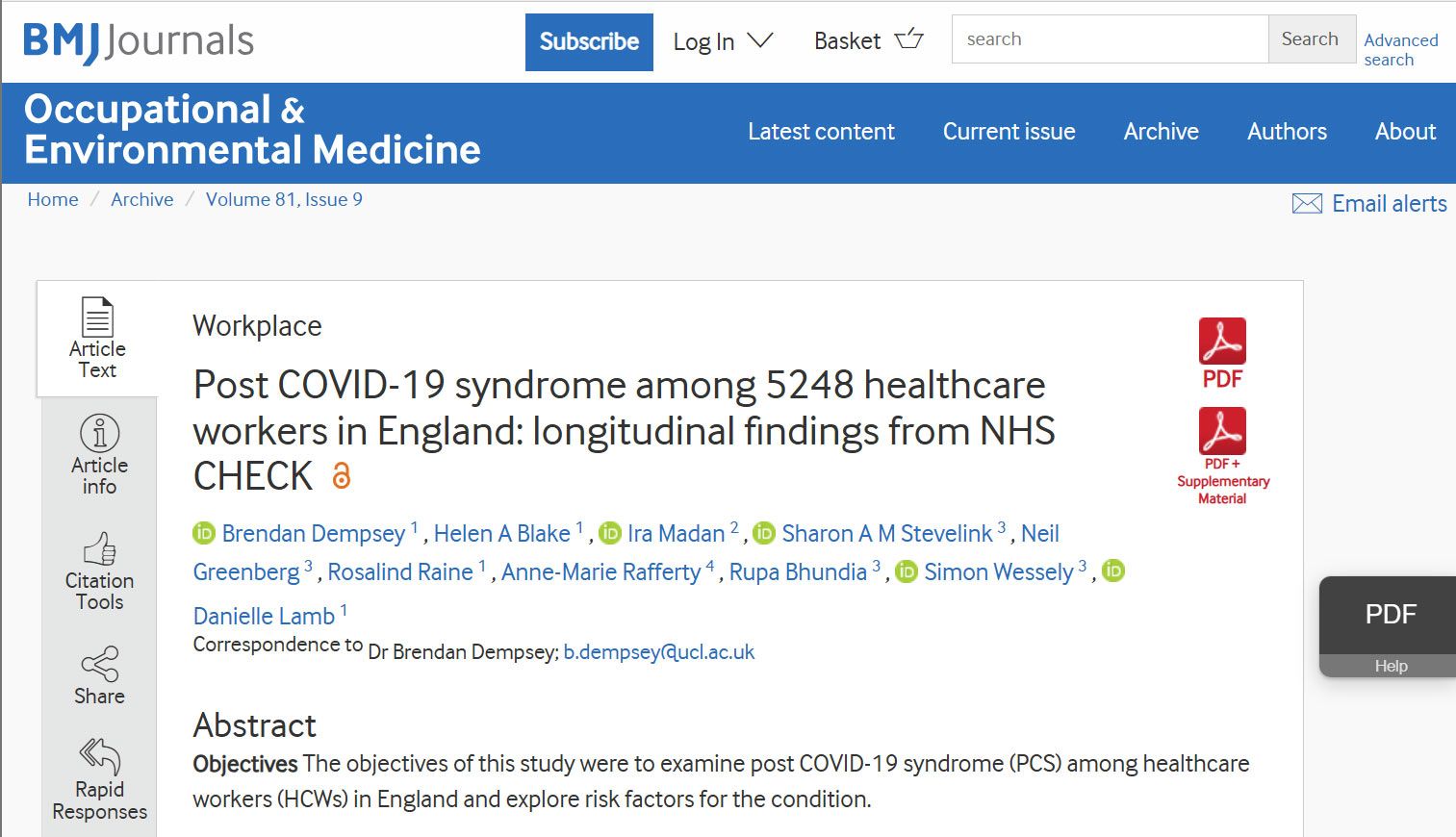
‘Post-COVID-19 syndrome among 5248 healthcare workers in England: longitudinal findings from NHS CHECK.’
© 2024 Dempsey et al / BMJ Journals ~ Occupational & Environmental Medicine.
❦ Post-COVID-19 syndrome among 5248 healthcare workers in England: Longitudinal findings from NHS CHECK
By Dempsey et al / BMJ Journals ~ Occupational & Environmental Medicine (8 Oct 2024)
Abstract
‘The objectives of this study were to examine Post-COVID-19 syndrome (PCS) [PASC/‘Long Covid’] among healthcare workers (HCWs) in England and explore risk factors for the condition.’
Methods
‘Data were collected by National Health Service (NHS) CHECK, a longitudinal study exploring HCWs’ mental and physical well-being during and after the [emergency phase of the] COVID-19 pandemic.
NHS CHECK collected data at four timepoints: the baseline survey between April 2020 and January 2021, and then three follow-up surveys at approximately 6, 12 and 32 months post baseline. PCS data were collected at 12 and 32 months, while risk factor data were from baseline.
HCWs were asked what COVID-19 symptoms they experienced and for how long and were classified as having PCS if they had any symptom for ≥12 weeks. Multi-level regressions were used to examine risk factors for PCS.’
Results
‘This study included 5248 HCWs. While 33.6% reported prolonged COVID-19 symptoms consistent with PCS, only 7.4% reported a formal diagnosis of PCS.’
‘Fatigue, difficulty concentrating, insomnia and anxiety or depression were the most common PCS symptoms.
Baseline risk factors for reporting PCS included screening for common mental disorders, direct contact with COVID-19 patients, pre-existing respiratory illnesses, female sex and older age.’
Conclusions
‘While a third of HCWs reported prolonged COVID-19 symptoms consistent with PCS, a smaller percentage reported a formal diagnosis of the condition.
We replicate findings that direct contact with COVID-19 patients, older age, female sex, pre-existing respiratory illness and symptoms of common mental disorders are associated with increased risk of PCS.’
Notes
‘Healthcare workers (HCWs) were [sic] at high risk to COVID-19 infection.
In the UK, research using data from the ONS COVID-19 Infection Survey found that HCWs were at higher risk of contracting COVID-19 compared with non-essential workers, though this effect reversed by June 2021.
Another study found that HCWs were among the occupational groups to self-report higher prevalences of COVID-19 symptoms lasting 4 or more weeks.
ONS mortality data revealed that those working in the healthcare sector were more likely to die of COVID-19 in 2020 compared with other industries, with this effect diminishing thereafter.
‘Given the increased risk of COVID-19 infection among HCWs, particularly early in the pandemic, they are likely to be at high risk of PCS.
This may also be the case for other essential workers, with educators, bus and coach drivers, and police and protective services staff also at increased risk.’
Due to the associated symptoms and lack of a known mechanism, PCS has drawn comparisons with other conditions, such as myalgic encephalomyelitis / chronic fatigue syndrome (ME/CFS).
ME/CFS is a long-term condition defined by post-exertional malaise, which may have a delayed onset, physical and mental fatigue and fatigability, issues with sleeping, memory or concentration, and functional impairment, which may be substantial.
Diagnoses are made if the defining symptoms last for 6 months or longer and cannot be attributed to an alternative cause.’
Risk factors for PCS
‘We found a very strong association between meeting the GHQ-12 cut-off score at baseline, indicating probable CMDs, and reporting PCS symptoms at follow-up.
Having direct contact with COVID-19 patients also had a very strong association with reporting PCS symptoms, while having asthma/COPD or female sex had a strong association.
Associations were also observed for age, as those aged between 51 and 60 were more likely to report PCS, and job role, where doctors were less likely to report PCS.’
‘Associations were also observed for age, as those aged between 51 and 60 were more likely to report PCS, and job role, where doctors were less likely to report PCS.’
✾
📖 (8 Oct 2024 ~ BMJ Journals: Occupational & Environmental Medicine) Post-COVID-19 syndrome among 5248 healthcare workers in England: Longitudinal findings from NHS CHECK ➤
© 2024 Dempsey et al / BMJ Journals ~ Occupational & Environmental Medicine.
✾
More... On Healthcare Workers



More... Healthcare Worker insights