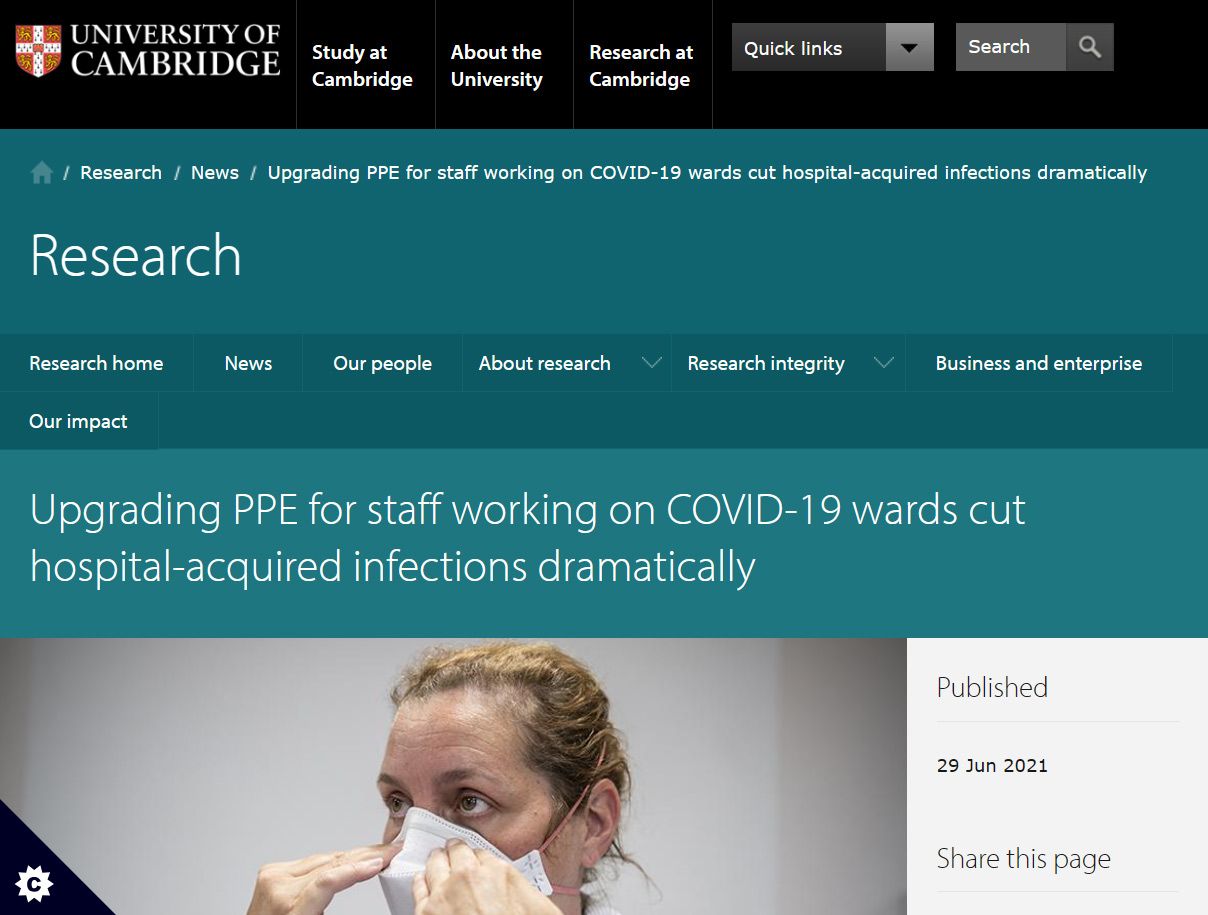
📖 Upgrading PPE for staff working on COVID-19 wards cut hospital-acquired infections dramatically

University of Cambridge / Cambridge University Hospitals (CUH) NHS Foundation Trust • 29 June 2021

‘When Addenbrooke’s Hospital in Cambridge upgraded its face masks for staff working on COVID-19 wards to Filtering Face Piece 3 (FFP3) respirators, it saw a dramatic fall – up to 100% – in hospital-acquired SARS-CoV-2 infections among these staff.’


‘Upgrading PPE [Personal Protective Equipment] for staff working on COVID-19 wards cut hospital-acquired infections dramatically’.


© 2021 University of Cambridge / Cambridge University Hospitals (CUH) NHS Foundation Trust.


Upgrading PPE for staff working on COVID-19 wards cut hospital-acquired infections dramatically


By University of Cambridge / Cambridge University Hospitals (CUH) NHS Foundation Trust (29 Jun 2021)


‘When Addenbrooke’s Hospital in Cambridge upgraded its face masks for staff working on COVID-19 wards to Filtering Face Piece 3 (FFP3) respirators, it saw a dramatic fall up to 100% – in hospital-acquired SARS-CoV-2 infections among these staff.


“Upgrading the equipment so that FFP3 masks are offered to all healthcare workers caring for patients with COVID-19 could reduce the number of infections, keep more hospital staff safe and remove some of the burden on already stretched healthcare services caused by absence of key staff due to illness.”


Until recently, UK Infection Protection Control [IPC] guidance recommended that healthcare workers caring for patients with COVID-19 should use fluid resistant surgical masks type IIR (FRSMs) as respiratory protective equipment; if aerosol-generating procedures were being carried out (for example inserting a breathing tube into the patient’s windpipe), then the guidance recommended the use of an FFP3 respirator.


The guidance has recently been updated to oblige NHS organisations to assess the risk that COVID-19 poses to staff and provide FFP3 respirators where appropriate.


Since the start of the pandemic, CUH [Cambridge University Hospital] has been screening its healthcare workers regularly for SARS-CoV-2, even where they show no symptoms.


They found that healthcare workers caring for patients with COVID-19 were at a greater risk of infection than staff on non-COVID-19 wards, even when using the recommended respiratory protective equipment.


As a result, its infection control committee  implemented a change in respiratory protective equipment for staff on COVID-19 wards, from FRSMs to FFP3 respirators.


Prior to the change in respiratory protective equipment, cases were higher on COVID-19 wards compared with non-COVID-19 wards in seven out of the eight weeks analysed by the team.


Following the change in protective equipment, the incidence of infection on the two types of ward was similar.


The results suggest that almost all cases among healthcare workers on non-COVID-19 wards were caused by community-acquired infection, whereas cases among healthcare workers on COVID-19 wards were caused by both community-acquired infection and direct, ward-based infection from patients with COVID-19 – but that these direct infections were effectively mitigated by the use of FFP3 respirators.


To calculate the risk of infection for healthcare workers working on COVID-19 and non-COVID-19 wards, the researchers developed a simple mathematical model.


Dr Mark Ferris from the University of Cambridge’s Occupational Health Service, one of the study’s authors, said:


“Healthcare workers – particularly those working on COVID-19 wards – are much more likely to be exposed to coronavirus, so it’s important we understand the best ways of keeping them safe.


“Based on data collected during the second wave of the SARS-CoV-2 pandemic in the UK, we developed a mathematical model to look at the risks faced by those staff dealing with COVID-19 patients on a day to day basis.


“This showed us the huge effect that using better PPE could have in reducing the risk to healthcare workers.”


According to their model, the risk of direct infection from working on a non-COVID-19 ward was low throughout the study period, and consistently lower than the risk of community-based exposure.


By contrast, the risk of direct infection from working on a COVID-19 ward before the change in respiratory protective equipment [from FRSM surgical masks to FFP3s] was considerably higher than the risk of community-based exposure: staff on COVID-19 wards were at 47 times greater risk of acquiring infection while on the ward than staff working on a non-COVID-19 ward.


Crucially, however, the model showed that the introduction of FFP3 respirators provided up to 100% protection against direct, ward-based COVID-19 infection.


Dr Chris Illingworth from the MRC Biostatistics Unit at the University of Cambridge, said:


“Before the face masks were upgraded, the majority of infections among healthcare workers on the COVID-19 wards were likely due to direct exposure to patients with COVID-19.


“Once FFP3 respirators were introduced, the number of cases attributed to exposure on COVID-19 wards dropped dramatically – in fact, our model suggests that FFP3 respirators may have cut ward-based infection to zero.”


Dr Nicholas Matheson from the Department of Medicine at the University of Cambridge, said:


“Although more research will be needed to confirm our findings, we recommend that, in accordance with the precautionary principle, guidelines for respiratory protective equipment [RPE] are further revised until more definitive information is available.”


Dr Michael Weekes from the Department of Medicine at the University of Cambridge, added:


“Our data suggest there’s an urgent need to look at the PPE offered to healthcare workers on the frontline.”


“Upgrading the equipment so that FFP3 masks are offered to all healthcare workers caring for patients with COVID-19 could reduce the number of infections, keep more hospital staff safe and remove some of the burden on already stretched healthcare services caused by absence of key staff due to illness.


“Vaccination is clearly also an absolute priority for anyone who hasn’t yet taken up their offer.”’


Vaccination is clearly also an absolute priority for anyone who hasn’t yet taken up their offer.

📖 (29 Jun 2021 ~ University of Cambridge / Cambridge University Hospitals (CUH) NHS Foundation Trust) Upgrading PPE for staff working on COVID-19 wards cut hospital-acquired infections dramatically ➤


© 2021 University of Cambridge / Cambridge University Hospitals (CUH) NHS Foundation Trust.


More... On Nosocomial (hospital-acquired or healthcare-associated) SARS-CoV-2 infection

'The Approved List of biological agents'. Advisory Committee on Dangerous Pathogens / UKHSA.
by United Kingdom Health Security Agency (UKHSA) / Health & Safety Executive (HSE) / Control of Substances Hazardous to Health Regulations (COSHH) / C19.Life 23 October 2025
The Health and Safety Executive (HSE) has designated SARS-CoV-2, the virus that causes COVID-19, a Hazard Group 3 (HG3) pathogen that can cause severe human disease. The United Kingdom’s Health Security Agency (UKHSA) classifies SARS-CoV-2 as a notifiable organism, and COVID-19 as a notifiable disease (2025).
by The British Occupational Hygiene Society ~ COSHH and Healthcare Respiratory Protection 20 October 2025
‘FRSMs [Surgical Masks] have never been considered either adequate or suitable equipment for protection against inhalable or respirable risks under COSHH.’
by Dempsey et al / BMJ Journals ~ Occupational and Environmental Medicine 8 October 2024
‘This study included 5248 healthcare workers. While 33.6% reported prolonged COVID-19 symptoms consistent with PCS, only 7.4% reported a formal diagnosis of PCS. Fatigue, difficulty concentrating, insomnia, and anxiety or depression were the most common PCS [Post-COVID-19 Syndrome] symptoms. Baseline risk factors for reporting PCS included screening for common mental disorders, direct contact with COVID-19 patients, pre-existing respiratory illnesses, female sex and older age.’
by Professor Steve Robson MPH MD PhD ~ President, Australian Medical Association (AMA) 20 January 2024
❦ “Every single case in which a person with COVID-19 infects another person in a healthcare setting – patient, relative, or hospital staff member – is a significant failure of hospital procedures. Every single instance .”
by Professor Phil Banfield (BMA) & Dr. Barry Jones (CAPA) 22 December 2023
‘It is accepted that COVID-19 can be and is spread by the airborne route. The recent evidence given at the UK COVID-19 Inquiry clearly shows that aerosol transmission is a significant, and almost certainly the dominant, route of transmission for COVID-19.’ The British Medical Association (22 Dec 2023)
by Royal College of Nursing (RCN) (UK) 21 December 2023
‘The RCN is urging healthcare employers to assess the risk posed by COVID-19 and put appropriate safeguards in place for patients and staff. WHO [has] advised healthcare workers and health facilities to implement universal masking in health facilities, as well as appropriate masking, respirators and other personal protective equipment for health workers caring for suspected and confirmed COVID-19 patients; and to improve ventilation in health facilities.’ ✾ ❦ We’ve contacted chief nursing officers in all four UK countries and the UKHSA to find out what action will be taken in response to WHO’s statement on a new COVID-19 variant of interest. The RCN is asking for a revision to current guidelines , to introduce universal implementation of the two measures advised by the World Health Organization (WHO) to help protect healthcare staff against COVID-19. Earlier this week, in light of the new COVID JN.1 variant, WHO advised healthcare workers and health facilities to: implement universal masking in health facilities , as well as appropriate masking , respirators and other personal protective equipmen t for health workers caring for suspected and confirmed COVID-19 patients ; improve ventilation in health facilities . The existing national infection prevention and control manuals don’t require standardised masking for COVID-19, and decisions on respiratory protective equipment are left to local risk assessments. This is now inconsistent with WHO’s latest advice . We also have concerns about the adequacy of ventilation in general ward and outpatient areas within hospital buildings and believe that action must be taken to assess and improve this. Although evidence suggests that the global public health risks from the new variant are low, WHO has warned that onset of winter could increase the burden of respiratory infections in the Northern hemisphere. This comes when there are already unsustainable pressures on the health service. Figures show that there has been a rise in COVID-19 cases and hospitalisations , and the RCN argues that without proper protections , ill health could continue to rise in nursing staff and impact their ability to deliver safe and effective patient care . WHO has advised that it is continuously monitoring the evidence and will update the JN.1 risk evaluation as needed. The RCN is urging healthcare employers to assess the risk posed by COVID-19 and put appropriate safeguards in place for patients and staff . Our COVID-19 workplace risk assessment toolkit aims to help assess and manage the risks associated with respiratory infections such as COVID-19, highlights the duties of nursing staff in specific roles (such as health and safety reps), has advice for employers and leaders, and provides the latest information on risk assessment. ❂ 📖 (21 Dec 2023 ~ Royal College of Nursing / RCN Magazine) COVID JN.1 variant: RCN seeks assurance on new PPE advice ➤ © 2023 Royal College of Nursing (RCN).
by Bland et al / Occupational Medicine 11 December 2023
❦ ‘As a consequence of their occupation, doctors and other healthcare workers were at higher risk of contracting coronavirus disease 2019 (COVID-19), and more likely to experience severe disease compared to the general population. Post-acute COVID (Long COVID) in UK doctors is a substantial burden. Insufficient respiratory protection could have contributed to occupational disease, with COVID-19 being contracted in the workplace , and resultant post-COVID complications. Although it may be too late to address the perceived determinants of inadequate protection for those already suffering with Long COVID, more investment is needed in rehabilitation and support of those afflicted .’ ❂ 📖 (11 Dec 2023 ~ Occupational Medicine) Post-acute COVID-19 complications in UK doctors: results of a cross-sectional survey ➤
by Dr. Lisa Iannattone, Assistant Professor of Dermatology 7 July 2023
❦ “The truth is that SARS2 is so contagious, so virulent, and reinfects so easily that there is no off-ramp for masking in healthcare. At least not without better vaccines and therapeutics that actually stop transmission and prevent Long Covid, Cardiovascular Covid and Neurocovid.”
by Dr. Lisa Iannattone, Assistant Professor of Dermatology 8 June 2023
❦ “Whenever I hear someone ask if we’re expected to continue masking in healthcare settings forever, I immediately think of Semmelweis – the man who discovered that healthcare workers’ dirty hands were causing fever and death in patients. The result of his discovery wasn’t the widespread implementation of hand hygiene though... Instead he was shunned, ostracized, lost his job and eventually institutionalized. It took around fifty years before the life-saving value of hand-washing was fully recognized in healthcare. Fifty years. It turns out that doctors didn’t take kindly to the idea that their own hands were unhygienic – and the source of disease and death for some of their patients. Despite the evidence, the denial was rampant and it was strong. The majority consensus was that Semmelweis was a crank... The resistance to the idea that the air we exhale while caring for patients can be unhygienic, and a source of illness and death for some, feels exactly the same to me. Despite the evidence, the denial is strong. Many prefer to cling to the status quo they knew before the pandemic. But that status quo was when we didn’t know better, and when we didn’t have such a virulent and dangerous new airborne pathogen in permanent circulation. Now that we do, and now that we know better, we should be willing to do better. So if the air we breathe can be unhygienic, and cause illness and death in our patients, and we know there’s a simple, effective solution – filtering it through a respirator – then it seems logical that this would become the new standard in our clinics, hospitals and long-term care facilities. Permanently. But as with Semmelweis’ experience, I expect that suggestion to get a lot of pushback, and for it to take a very long time for the medical field to accept that the old status quo is gone, and that masking in healthcare is the new normal. I just hope it won’t take another fifty years.”
by Dr. Lisa Iannattone, Assistant Professor of Dermatology 22 October 2022
❦ Medical school lectures on respiratory pathogens in 2060: “Interestingly in the 1900s and early 2000s, doctors thought respiratory viruses were transmitted by fomites, not aerosols. They spent a tremendous amount of energy cleaning hands and surfaces instead of cleaning indoor air. Unsurprisingly, they were quite terrible at limiting the spread of respiratory viruses and had terrible epidemics each year leading to thousands of deaths, including many among infants and young children.” “Air hygiene has been one of the greatest public health advancements of the century.”
by The Royal College of Nursing (RCN/UK) and The British Medical Association (BMA) 21 January 2021
‘Our very serious concerns relate to the risk of aerosol/airborne infection; RCN and BMA members working in all settings are raising concerns that they are not adequately protected. Our members are concerned that fluid-repellent surgical face masks [FRSM] and face coverings, as currently advised in most general healthcare settings, do not protect against smaller more infective aerosols. ’

More... On waning vaccine protection, and increased risk of all-cause mortality via SARS-CoV-2 reinfections


by C19.Life... et al 29 September 2025
‘The arrival of the Omicron variant marked a major shift, introducing numerous extra mutations in the spike gene compared with earlier variants. Before Omicron, natural infection provided strong and durable protection against reinfection, with minimal waning over time. However, during the Omicron era, protection was robust only for those recently infected, declining rapidly over time and diminishing within a year.’
by C19.Life... et al 7 September 2025
‘Vaccine effectiveness against SARS-CoV-2 [COVID-19] infection declines markedly with time and Omicron variants.’ from ‘Effectiveness of COVID-19 vaccines against SARS-CoV-2 infection and severe outcomes in adults’ by Zhou et al / European Respiratory Review (2024).