📖 The Impact of the COVID-19 Pandemic on Dementia Risk: Potential Pathways to Cognitive Decline

Pyne and Brickman / Neurodegenerative Diseases • 28 July 2021

‘SARS-CoV-2 infection initiates a disease progression that has the potential to promote cognitive decline and exacerbate pre-existing dementia.’


SARS-CoV-2 infection, moderated in severity by age-, sex-, and race/ethnicity-dependent factors, initiates a disease progression that has the potential to promote cognitive decline and exacerbate pre-existing dementia.


The damage cascade of COVID-19 is multi-faceted and interdependent, with multiple pathways that could lead to cognitive hazard mechanisms.


One such cognitive hazard mechanism, cerebral direct infection, is possible with the SARS-CoV-2 virus, exhibiting neuroinvasive  and neurotropic characteristics with neurovirulent potential.


The greatest cognitive risk though may be from immune-mediated damage originating as cytokine storms that have far-reaching consequences for multiple organ systems, including the brain.


Damage to organ systems and detrimental immune response, across the disease progression of COVID-19, may affect cognition via cerebral ischemia, hypoxia/acidosis, and neuroinflammation.


The initiation of a coagulation cascade, from excessive immune response, which can generate micro-/macro-thromboemboli also poses significant risk.


While long-term cognitive outcomes have not been fully evaluated, emerging reports indicate high rates of long-term symptoms and cognitive alterations in recovered COVID-19 patients.


Due to these plausible COVID-19 cognitive decline pathways, evidence of prevalent neurological symptoms in patients, and long-term symptoms in recovered individuals, our conclusion is that CO­VID-19 represents a credible risk for cognitive decline and has the potential to exacerbate pre-existing dementia.


For those at higher baseline dementia risk, older adults, those with cardiovascular risk factors, and people of color, COVID-19 may not only increase the risk of cognitive decline but also interact in a synergistic way with pre-existing dementia risk factors to disproportionately increase this dementia risk.’


📖 (28 Jul 2021 ~ Neurodegenerative Diseases) The Impact of the COVID-19 Pandemic on Dementia Risk: Potential Pathways to Cognitive Decline ➤


© 2021 Pyne and Brickman / Neurodegenerative Diseases.
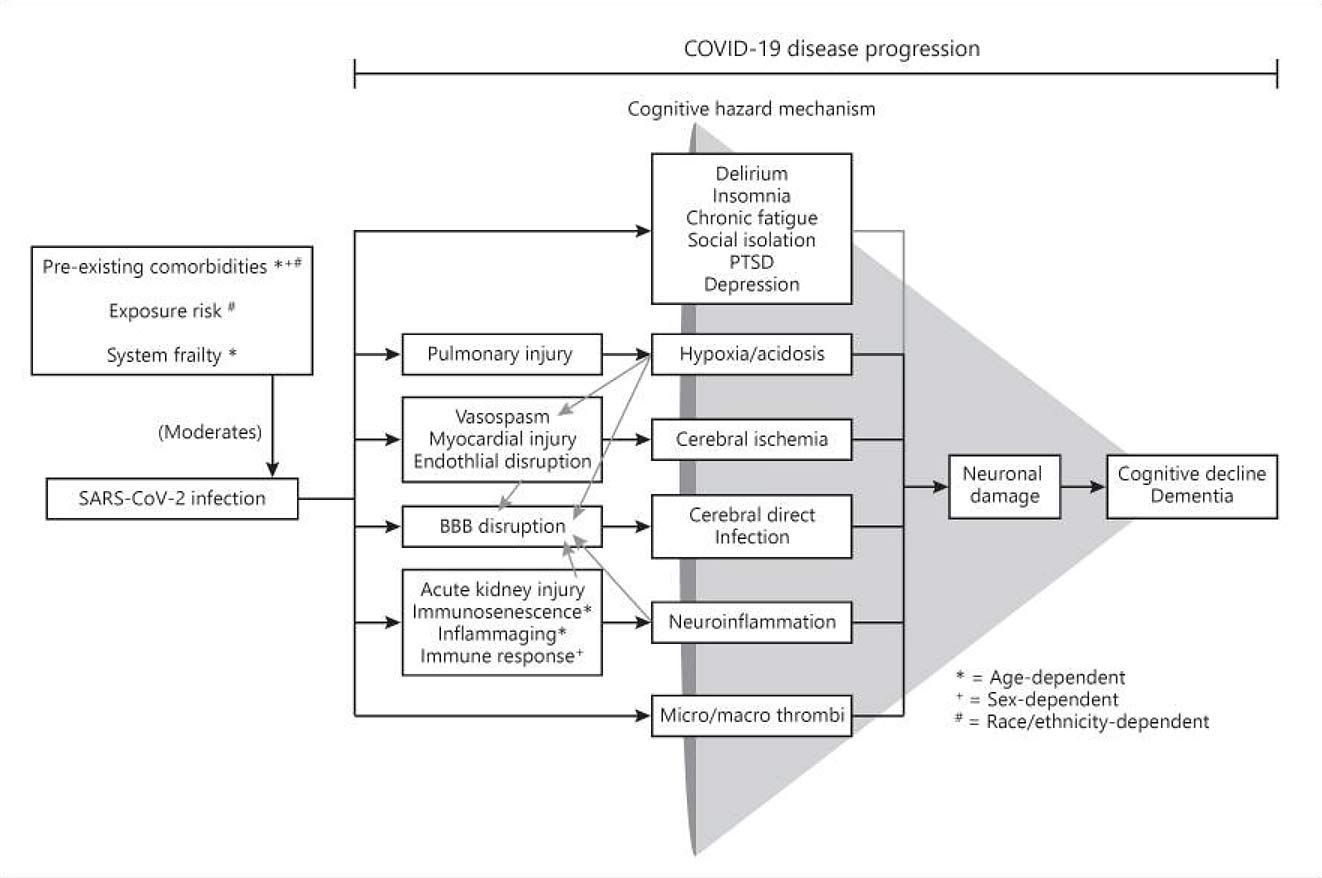

‘SARS-CoV-2 infection, with age-, sex-, and race/ethnicity-dependent moderators that influence severity, initiates interdependent damage pathways that have the potential to cascade toward the outcome consequence of long-term cognitive decline and/or dementia.


Lighter gray arrows represent conditional influences.’


📖 (28 Jul 2021 ~ Neurodegenerative Diseases) The Impact of the COVID-19 Pandemic on Dementia Risk: Potential Pathways to Cognitive Decline ➤


© 2021 Neurodegenerative Diseases.

by C19.Life... et al 21 November 2025
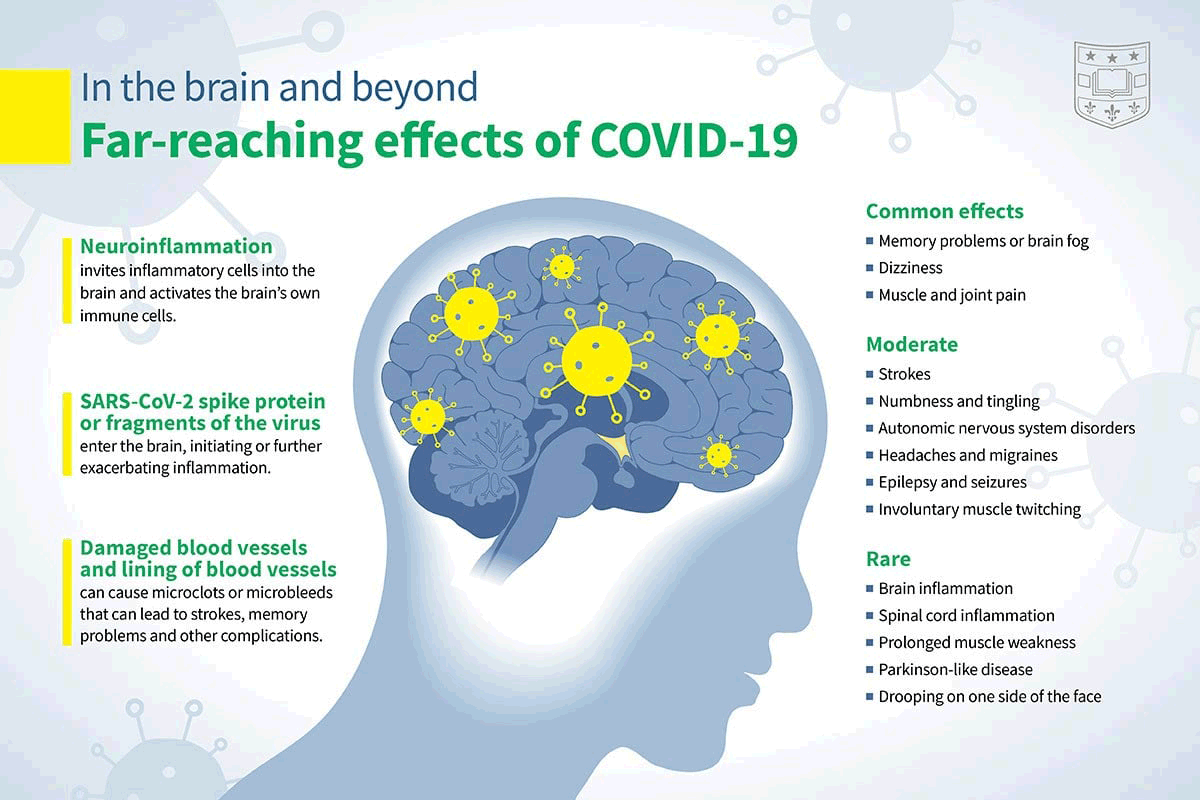
‘Although COVID-19 was originally considered a respiratory illness, it is now well established that SARS-CoV-2 infection can have far-reaching impacts on the nervous system. Common neurological symptoms in Long COVID [PASC] include new-onset cognitive difficulties, dysautonomia, fatigue, and peripheral neuropathy.’ from ‘Neuroimmune pathophysiology of long COVID’ by Moen et al / Psychiatry and Clinical Neurosciences (2025).
by News Medical Life Sciences ❂ Duff et al / Nature Medicine 2 February 2025
‘Scientists discover that even mild COVID-19 can alter brain proteins linked to Alzheimer’s disease, potentially increasing dementia risk. COVID-19-positive individuals exhibited lower cognitive test performance compared to controls – equivalent to almost two years of age-related cognitive decline. ’
by Dr. David Joffe PhD / FRACP (Respiratory Physician) 27 January 2024
❦ “It’s really not in the interest of the virus to kill us quickly. That’s why it has mutated to immune escape. That way it enters silently, and then eats you slowly whilst you’re still a spreading vector. Refrigerator trucks are long gone. That’s all the political class wanted. The unseen costs of CVD [cardiovascular disease] , DM [diabetes mellitus] , and both dementia and Parkinson’s Disease are the train coming down the tunnel. The economists are catching up. The actuaries are already there. Politicians and most people? Not yet...” ❂ © 2024 Dr. David Joffe PhD / FRACP (Respiratory Physician) ➲
by Shajahan et al / Frontiers in Aging Neuroscience 8 January 2024
‘[COVID-19’s] ability to invade the central nervous system through the hematogenous and neural routes, besides attacking the respiratory system, has the potential to worsen cognitive decline in Alzheimer’s disease patients. The severity of this issue must be highlighted.’
by Conor Browne 8 May 2023
❦ ‘A significant part of my professional role is forecasting: that is to say, quantifying the risks faced by commercial and other organisations in the future as a result of SARS-CoV-2 and other pathogens (especially H5N1). As such, I often produce bespoke scenarios for clients – 6 months, 12 months, 24 months into the future – assigning probabilities to each scenario occurring. As this article * makes clear, the risk of the emergence of a new Variant of Concern (VOC) within the next two years is about 20 percent. * 📖 (5 May 2023 ~ CNN) Covid-19 experts say they warned White House about chance of an Omicron-level event within the next two years ➤ Any risk manager reading this will know that this is a highly significant risk. Biological risks do not exist in isolation; rather, they are nested within both the domestic politics of any given jurisdiction, and within geopolitics in general. This is a very important point to remember. The recent declaration by the WHO * has (rightfully) angered many people – but, frankly, it has made little practical difference to what I do professionally. * 📖 (5 May 2023 ~ CNN) WHO says Covid-19 is no longer a global health emergency ➤ The vast majority of national governments essentially stopped addressing C-19 in any serious manner quite some time ago. This is the key domestic political risk that intersects with the biological risk of the emergence of a new VOC. National apathy regarding C-19, combined with the growing mainstreaming of both anti-vax sentiment and a reduction in infection control measures in general (such as dropping respirator use in healthcare environments), has created a very dangerous situation. In short, as a global society, we are less prepared now for either the emergence of another disease with pandemic potential (specifically H5N1 avian influenza), or the emergence of a SARS-CoV-2 VOC that exhibits significant immune evasion around current vaccines, than we were in 2019. If either – or both – of these were to occur within the next couple of years, we would be in deep, deep trouble. Currently, we are allowing SARS-CoV-2 to transmit entirely unchecked; this means that pressures on healthcare systems globally will inexorably continue to increase. Concurrently, the population of many jurisdictions worldwide are now primed to reject even the lightest of societal non-pharmaceutical interventions (NPIs) [ such as respirator/mask mandates ] . This combination virtually guarantees that should an immune-evasive VOC emerge we would see healthcare system collapse in many jurisdictions. The short-term goals of domestic politics (maintaining or attaining political power) relies on shying away from the discussion of anything to do with the pandemic. This is the tragic ground truth that has a high chance of coming back to bite us all very badly soon.’ © 2023 Conor Browne . ➲
by EurekAlert / Journal of Alzheimer’s Disease Reports 4 April 2023
‘All subtypes of dementia, irrespective of patients’ previous dementia types, behaved like rapidly progressive dementia following COVID-19 [infection with SARS-CoV-2] .’
by Davis et al / Journal of Alzheimer’s Disease 13 September 2022
‘Older people who were infected with COVID-19 show a substantially higher risk – as much as 50% to 80% higher – of developing Alzheimer’s disease within a year. And the highest risk was observed in women at least 85 years old.’