Flu vs. SARS-CoV-2: πŸ“– Secondary bacterial infection in COVID-19 patients is a stronger predictor for death compared to influenza patients

Shafran et al / Nature: Scientific Reports • 16 June 2021

‘Secondary bacterial infection is a notable complication associated with worse outcomes in COVID-19 than influenza patients.’
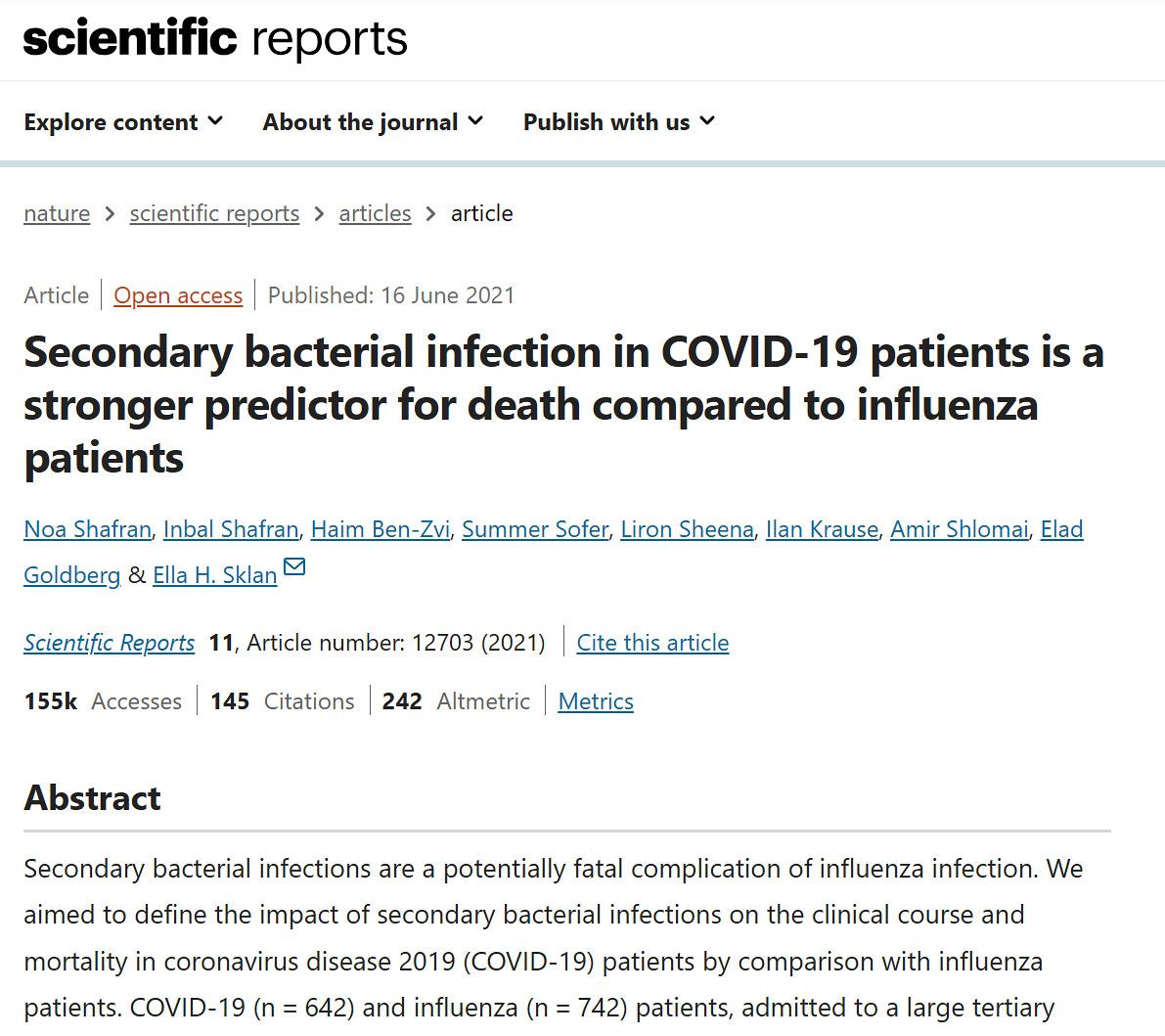
πŸ“– (16 Jun 2021 ~ Nature: Scientific Reports) Secondary bacterial infection in COVID-19 patients is a stronger predictor for death compared to influenza patients’.


© 2021 Shafran et al / Nature: Scientific Reports.


❦ Study ~ ‘Secondary bacterial infection in COVID-19 patients is a stronger predictor for death compared to influenza patients’


By Shafran et al / Nature: Scientific Reports (16 Jun 2021)


❦ ‘Secondary bacterial infections are a potentially fatal complication of influenza infection.


We aimed to define the impact of secondary bacterial infections on the clinical course and mortality in coronavirus disease 2019 (COVID-19) [SARS-CoV-2-infected] patients by comparison with influenza patients.


COVID-19 (n = 642) and influenza (n = 742) patients, admitted to a large tertiary center in Israel and for whom blood or sputum culture had been taken were selected for this study. Bacterial culture results, clinical parameters, and death rates were compared.


COVID-19 patients had higher rates of bacterial infections than influenza patients (12.6% vs. 8.7%).’


Notably, the time from admission to bacterial growth was longer in COVID-19 compared to influenza patients (4 (1–8) vs. 1 (1–3) days).


Late infections (more than 48 hours after admission) with gram-positive bacteria were more common in COVID-19 patients (28% vs. 9.5%).’


Secondary infection was associated with a higher risk of death  in both patient groups 2.7-fold (1.22–5.83) for COVID-19, and 3.09-fold (1.11–7.38) for Influenza).


‘The association with death remained significant upon adjustment to age and clinical parameters in COVID-19 but not in influenza infection.’


Secondary bacterial infection is a notable complication associated with worse outcomes in COVID-19 than influenza patients.’


Secondary bacterial infection is a notable complication associated with worse outcomes in COVID-19 than influenza patients.


❂


πŸ“– (16 Jun 2021 ~ Nature: Scientific Reports) Secondary bacterial infection in COVID-19 patients is a stronger predictor for death compared to influenza patients ➀


© 2021 Shafran et al / Nature: Scientific Reports.


More...  SARS-CoV-2 and Flu


by CIDRAP ❂ Cai et al / The Lancet: Infectious Diseases 2 April 2025
‘These findings have important implications for understanding the potential impact of COVID-19 on long-term immune function and susceptibility to pathogens.’
by Carolyn Barber / Fortune & Outbreak Updates 14 December 2023
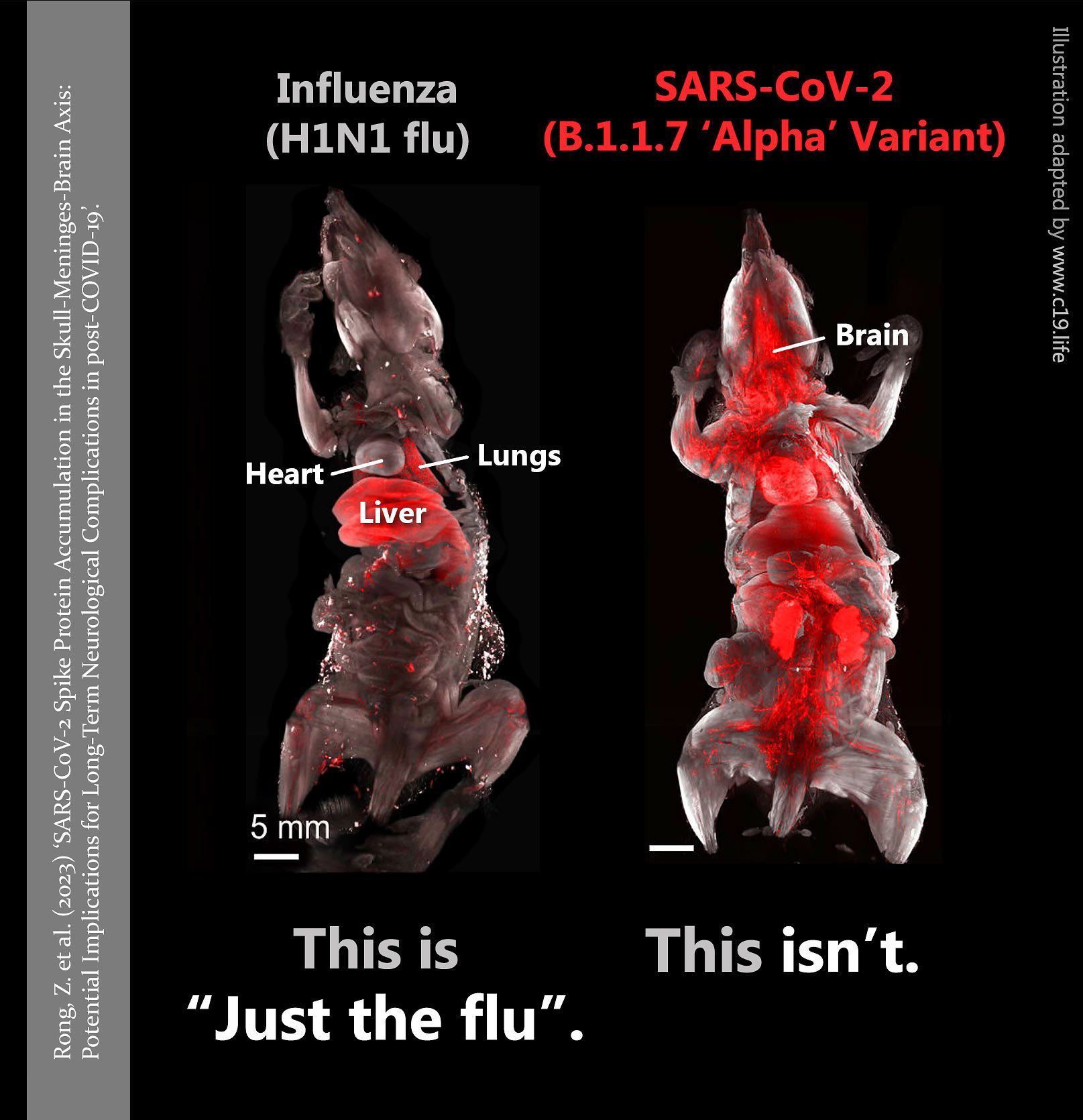
❦ ‘Al-Aly’s study undertook a comparative analysis of 94 pre-specified health outcomes and found that over 18 months of follow-up, COVID was associated with a “ significantly increased risk ” for 64 of them, or nearly 70% . The disease’s enhanced risk list includes everything from cardiac arrest , stroke , chronic kidney disease , and cognitive impairment to mental health and fatigue , characteristics often associated with long COVID. By comparison, the seasonal flu was associated with increased risk in only 6 of the 94 conditions specified. Further, while COVID increased the risks for almost all the organ systems studied, the flu heightened risk primarily for the pulmonary ( lung ) system . Those findings, Al-Aly says, suggest that “ COVID is really a multi-systemic disease , and flu is more a respiratory virus ”.’ ❂ πŸ“– (14 Dec 2023 ~ Fortune) COVID-19 v. Flu: A ‘much more serious threat,’ new study into long-term risks concludes ➀ πŸ“– (14 Dec 2023 ~ The Lancet) Long-term outcomes following hospital admission for COVID-19 versus seasonal influenza: a cohort study ➀ © 2023 Carolyn Barber / Fortune .
by Dr. Lisa Iannattone, Assistant Professor of Dermatology 1 October 2022
❦ “Immunity debt” is making the rounds again. So here’s my reminder that while there are viruses that are more severe if caught as a teen or adult (like polio or chickenpox), that isn’t the case for respiratory viruses . There’s a mortality benefit from first RSV and flu infections being delayed. So no, your toddler doesn’t need to catch all the viruses before the age of two to “build their immune system”. In fact, it’s the opposite: infants and young toddlers are more at risk of hospitalization and death from many respiratory viruses at their age than older children. You know how we’re asked not to give kids honey until they’re one? Or how Health Canada has a whole list of unsafe foods for kids under five? “ For many pathogens, kids are more susceptible to severe outcomes when they’re very young. ” And there is benefit to delaying exposure. This new (and very politically convenient) idea that it’s always best to catch pathogens very early in life “to build your immune system” can actually be quite dangerous when you take the time to think it all the way through. Stop blindly promoting “immunity debt” pseudoscience. Three years ago, I never would have believed that I’d one day see scientists and MDs [medical doctors] promoting the idea that it’s good for infants and young toddlers to be exposed to dangerous respiratory viruses like flu and RSV, instead of trying to delay those first infections – and yet here we are.”
by Hayley Muendlein / The Conversation 17 August 2022
❦ The 1918 influenza pandemic resulted in the loss of over 3% of the world’s population – at least 50 million people. But it wasn’t the flu virus that caused the majority of these deaths. An analysis of lung samples collected during that flu pandemic indicated that most of the deaths were likely due to bacterial pneumonia , which ran rampant in the absence of antibiotics. Even in more recent history, like the 1957 H2N2 and 2009 H1N1 flu pandemics , nearly 18% of patients with viral pneumonia had additional bacterial infections that increased their risk of death. And the COVID-19 pandemic is no different. ❂ ο»Ώ πŸ“– (17 Aug 2022 ~ The Conversation) When COVID-19 or flu viruses kill, they often have an accomplice – bacterial infections ➀ © 2022 Hayley Muendlein / The Conversation.
by Parkinson’s Foundation 22 February 2022
❦ It has long been suspected by scientists that the flu (influenza) might play a role in developing Parkinson’s disease (PD) later in life. Compared to those who were not diagnosed with the flu, there was a 90% higher risk of PD for those who had the flu 15 or more years earlier. Inflammation is clearly a factor in PD – and influenza is known to trigger an extreme inflammatory response in the body. ο»Ώ In light of the COVID-19 pandemic, and its known neurological consequences such as brain fog and loss of smell, continued robust research into how inflammation impacts the brain is warranted. ❂ πŸ“– (22 Feb 2022 ~ Parkinson's Foundation) The Flu Factor: Is There a Link to Parkinson's? ➀ © 2022 Parkinson’s Foundation.